
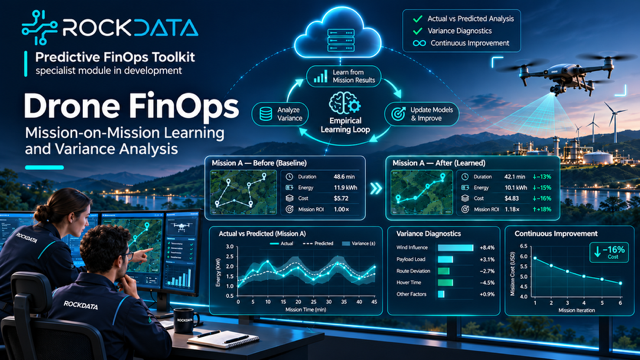
Excerpt: Forecasts acquire value when compared with reality. We combine Kolb’s experiential learning cycle, mission telemetry and financial variance analysis to investigate how Rockdata’s developing Drone Flight FinOps Module can improve operational decisions.
Every mission tests a prediction
Before a mission, we expect a certain duration, cost, energy consumption and quality of output.
After the mission, we have actual observations.
The difference between prediction and reality is an opportunity to learn.
However, simply recording the difference is not enough.
We must determine whether it arose from physical conditions, planning assumptions, equipment behavior, data quality or operational decisions.
This is the foundation of mission-on-mission improvement.
Define a mission variance
For financial cost:
For electrical energy:
A positive cost variance indicates that the mission exceeded its estimate.
But the variance does not identify its cause.
An unfavourable result might be explained by wind, increased preparation time, processing rework or poor forecasting.
We must separate observations from hypotheses.
Apply Kolb’s learning cycle
Concrete experience: Perform an approved mission and capture the actual telemetry and operating records.
Reflective observation: Compare forecasts with observed duration, energy consumption, costs and accepted outputs.
Abstract conceptualization: Develop explanations for significant deviations and determine whether the economic or physical model should change.
Active experimentation: Design a subsequent controlled experiment that tests one of those explanations.
Every cycle should improve either the model, the operating procedure or our understanding of uncertainty.
Avoid optimizing noise
A single flight rarely provides enough evidence to establish a reliable improvement.
Wind, battery condition, payload variation and measurement uncertainty can obscure small effects.
Where practical, compare repeated observations under similar conditions and report uncertainty.
Do not treat every difference as causal.
Equally, do not assume that an apparently lower-cost flight is superior if its safety margins or output quality were compromised.
From one mission to organizational knowledge
The long-term objective is a structured history of expected and actual performance.
Such a record can support:
- Forecast calibration.
- Identification of recurring cost overruns.
- Detection of unusual energy consumption.
- Better mission-duration estimates.
- Improvement of cost allocation.
- Evidence-based changes to operational procedures.
This knowledge can be reused across mission categories and aircraft configurations, subject to the limits of the underlying data.
The planned FinOps capability
The proposed Mission Variance and Empirical Learning Engine will investigate how to associate predicted costs, actual financial outcomes, flight telemetry and validated explanations.
Its purpose is to create a closed loop from forecasting to operational evidence and back to improved forecasting.
This is a research and development objective of the Rockdata Drone Flight FinOps Module.
Conclusion
The economic value of empirical learning comes from improving future decisions.
A mission that fails to meet its intended objective may still produce valuable evidence, provided the observations are accurately recorded and used.
The fundamental discipline is to learn systematically from differences between expected and actual outcomes.
Next: Drone FinOps — Fleet Economics, Real Options and Investment Decisions.
Rockdata research note: This article documents empirical learning research for the specialist Rockdata Drone Flight FinOps Module within the Rockdata Predictive FinOps Toolkit. The module is in development.