
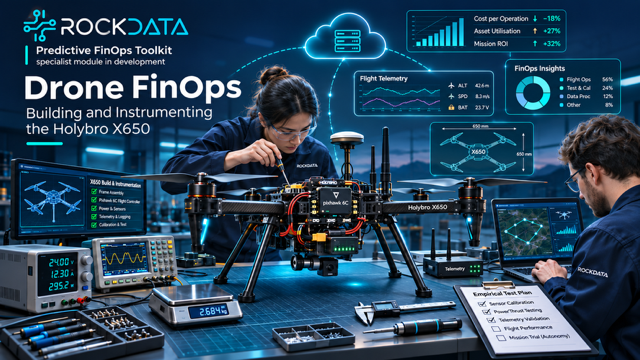
Excerpt: A drone becomes an empirical research platform only when we can measure its behavior reliably. We introduce the Holybro X650 build, telemetry, configuration management and experimental data collection for Rockdata’s Drone Flight FinOps Module.
Turning an aircraft into a measurement system
Building a drone establishes the physical capability to fly.
Instrumenting that drone establishes the capability to learn.
For economic research, we need to connect aircraft state, energy consumption, component configuration and mission outcomes.
This requires consistent measurements and traceable configuration records.
The Holybro X650 Development Kit provides a practical platform using a Pixhawk 6C or 6X, GPS, telemetry radio, four motors and ESCs.
The aircraft supports PX4 and ArduPilot, allowing the experimental architecture to be developed without committing immediately to one flight stack.
Establish the configuration baseline
Before flying, record the actual aircraft configuration.
Include:
- Frame and propulsion hardware.
- Pixhawk model and firmware.
- Battery type, mass and identifier.
- Propeller model and condition.
- Payload mass and mounting arrangement.
- Power-module type and calibration.
- Sensor and telemetry configuration.
A configuration should have its own identifier and version history.
Without this information, comparing two flight logs may be misleading. A change in battery, propeller or payload could explain a difference incorrectly attributed to mission planning.
Build and commission safely
Follow Holybro’s official X650 mechanical assembly instructions and the Pixhawk-specific wiring documentation.
Initial setup should include sensor calibration, power monitoring, receiver configuration where applicable, actuator assignment and failsafe configuration.
All motor testing must be performed with propellers removed.
The first flight should establish basic controllability and system integrity, not test the limits of the aircraft.
Only after reliable baseline operation should economic performance experiments begin.
Define the experimental data model
For each flight, capture:
Configuration: Aircraft, firmware, battery and payload.
Plan: Route, expected duration, energy budget and mission objective.
Telemetry: Flight duration, voltage, current, position, velocity and relevant actuator data.
Outcome: Mission completion status, accepted outputs and observed deviations.
Economics: Preparation time, battery wear allocation, processing requirements and associated costs.
The goal is to connect physical measurements to economic quantities using consistent identifiers.
Kolb experiment: validate telemetry
Compare the power module’s reported battery voltage against an appropriate independent measurement.
Verify that calculated electrical energy is consistent with logged voltage, current and time data.
Examine missing samples, timestamp consistency and unusual measurement values.
This is an exercise in measurement reliability before attempting sophisticated prediction.
The planned FinOps capability
The proposed Telemetry and Empirical Data Integration component of Rockdata Drone Flight FinOps will investigate a consistent data model for importing, validating and analyzing mission observations.
It is not necessary to build a complex application immediately.
A structured collection of configuration records, flight logs and reproducible analytical scripts can establish the foundation.
Conclusion
A flight log is evidence, but it does not automatically explain the aircraft’s behavior.
Reliable economic analysis requires trustworthy measurements, configuration traceability and explicit assumptions.
Instrumenting the drone converts operational activity into reusable engineering knowledge.
Next: Drone FinOps — Mission-on-Mission Learning and Variance Analysis.
Rockdata research note: This experiment contributes to the specialist Rockdata Drone Flight FinOps Module, currently in development within the Rockdata Predictive FinOps Toolkit.