
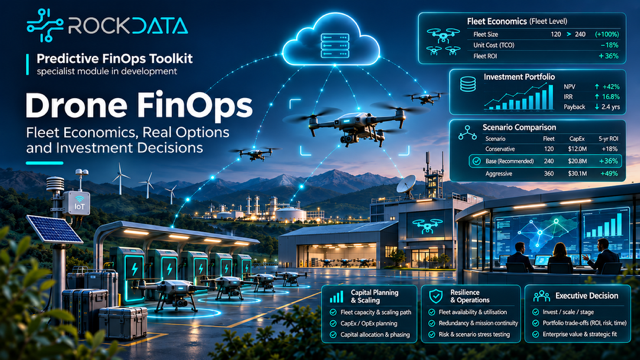
Excerpt: When should an operator invest in another aircraft, additional batteries or better computing infrastructure? We explore fleet economics, capacity constraints and staged investment as the concluding article in Rockdata’s Drone Flight FinOps research series.
The investment question has changed
We began by asking whether a portfolio of missions justified establishing a drone capability.
We then examined the costs of that capability: storage, planning, estimation, execution, data processing and maintenance.
Finally, we investigated how the aircraft’s physical properties and measured behavior affect those costs.
We can now return to the original business case with better information.
The question is no longer simply whether to buy a drone.
It is which investments improve the performance of the entire mission-delivery system.
More aircraft do not guarantee more throughput
Consider an operation with one aircraft, several batteries and one qualified operator.
Suppose mission demand increases.
Purchasing a second aircraft may be useful, but it will not necessarily double productivity.
The bottleneck could be operator availability, battery charging, weather windows, data processing or access to permitted operating areas.
Adding resources to a non-bottleneck activity can increase costs without proportionally increasing completed work.
Therefore, capacity planning must identify the limiting factor before additional investment.
Build a fleet economic model
For a portfolio involving several aircraft, aggregate cost includes:
These terms represent lifecycle and period-appropriate cost allocations, not necessarily cash expenditure occurring in the same month.
The objective is to compare feasible operational configurations on a consistent basis.
Useful indicators include accepted missions per period, cost per accepted outcome, resource utilization, resilience and expected economic contribution.
The value of waiting
Investment decisions can be staged.
Rather than purchasing a second aircraft immediately, we may conduct additional experiments with the existing Holybro X650.
This allows us to improve estimates of demand, actual energy consumption, maintenance requirements and mission acceptance rates.
The option to delay investment can be valuable when uncertainty is high.
However, delay also has costs. It may produce missed revenue, insufficient spare capacity or operational fragility.
Real-options reasoning requires considering both the value of flexibility and the opportunity cost of waiting.
Kolb experiment: compare investment scenarios
Construct three hypothetical operating configurations.
Scenario A: One aircraft with existing batteries and infrastructure.
Scenario B: One aircraft with additional battery capacity and improved processing resources.
Scenario C: Two aircraft with appropriately expanded operational resources.
For each scenario, simulate the same mission portfolio and operational constraints.
Compare cost per accepted mission, total contribution, missed deadlines, resource utilization and resilience.
Then vary mission demand and acceptance rates.
Which configuration performs well across multiple plausible futures?
Which investment remains useful if demand is lower than expected?
Which decision can be postponed until uncertainty has been reduced?
The planned FinOps capability
The proposed Fleet Investment and Real Options Analytics component of Rockdata Drone Flight FinOps will investigate:
- Fleet capacity forecasting.
- Shared-resource bottlenecks.
- Capital and operating cost scenarios.
- Mission portfolio contribution.
- Investment timing and staged commitments.
- Economic resilience under uncertain demand.
These remain proposed specialist capabilities rather than released product features.
The concluding principle
We have now connected the full economic sequence:
Business case → Aggregate costs → Storage and infrastructure → Planning and prediction → Mission optimization → Flight physics → Empirical measurement → Learning → Investment decisions.
Each stage informs the next, while observed outcomes continually revise the assumptions made earlier.
This is the foundation of a disciplined FinOps approach to autonomous operations.
The objective is not to maximize the number of drones or flights. It is to maximize sustainable value from an economically and physically constrained mission-delivery system.
About this research: This article concludes the introductory research series supporting the specialist Rockdata Drone Flight FinOps Module, currently in development as part of the Rockdata Predictive FinOps Toolkit. Proposed capabilities will be subject to further experimentation and validation.