
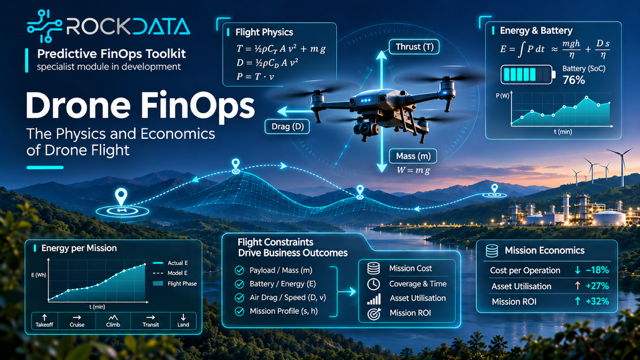
Excerpt: Every mission business case eventually encounters physical reality. We explore how mass, thrust, drag, battery energy and flight dynamics determine the economic feasibility of drone operations, and how these relationships inform the Rockdata Drone Flight FinOps Module under development.
Physics places limits on economic ambition
Until now, we have approached drone operations through business cases, aggregate costs, storage, estimation and scheduling.
But the economics of flight ultimately depends on physical constraints.
A drone cannot carry unlimited payload. A battery cannot provide unlimited energy. A mission cannot be made arbitrarily fast without consequences for power, stability or safety.
These constraints determine the feasible set of economic choices.
Our experimental platform is the Holybro X650 Development Kit, equipped with a Pixhawk flight controller.
The manufacturer quotes a 6.3 kg takeoff-weight limit and approximately 30 minutes of hover with a specified battery and no additional payload. These are reference specifications, not measurements of our assembled aircraft.
Mass and thrust
In steady, level hover:
An aircraft weighing 3.2 kg requires approximately 31.4 newtons of thrust.
Increasing mass to 3.7 kg increases the requirement to approximately 36.3 newtons.
The weight increase affects energy consumption, propulsion margin and potentially mission endurance.
Why power increases nonlinearly
Idealized rotor momentum theory provides:
Where (A) is effective rotor disk area and (\rho) is air density.
At constant disk area and air density, induced power increases faster than thrust.
This matters because a payload that increases mission value can also increase propulsion energy disproportionately.
Actual electrical power will differ because the motor, ESC, propeller and battery introduce additional losses.
Drag and mission speed
A simplified aerodynamic drag expression is:
Here, () is reference frontal area and () is a drag coefficient.
Drag increases approximately with the square of air-relative speed under the model’s assumptions.
This creates an important economic question.
Flying faster may increase power consumption, but reduce the time required to complete a route.
Therefore, minimum power and minimum energy per kilometer are not necessarily achieved at the same flight speed.
Wind further complicates the calculation because airspeed and ground speed differ.
Battery economics
A 6S 10 Ah battery has a nominal energy of approximately:
Actual usable energy is lower or otherwise different depending on battery condition, operating current, reserve policy and environmental conditions.
The aircraft also requires energy for control, communications, avionics and payload systems.
Thus, mission energy must be measured rather than inferred solely from nominal battery capacity.
Kolb experiment: identify the physical cost model
After safe assembly and commissioning, begin with a measured mass ledger and manufacturer specifications.
Develop theoretical predictions for hover thrust and power.
Use simulation to explore changes in payload and operating speed.
Then conduct conservative, controlled flights using approved configurations, collecting actual voltage, current, mass and flight-state measurements.
Compare observations against the physical predictions.
The objective is not to force measurements to agree with theory.
It is to determine where the simplified model is useful, where it fails and what additional variables are required.
The planned FinOps capability
The proposed Flight Physics and Energy Economics Model within Rockdata Drone Flight FinOps will investigate:
- Mass and payload sensitivity.
- Thrust and electrical power modeling.
- Energy demand across mission phases.
- Endurance prediction and operating reserves.
- Physical feasibility constraints.
- Economic sensitivity to aircraft configuration.
The model will be refined using measured X650 data. Until validated, its predictions should not be relied upon as flight safety limits.
Conclusion
The business case describes what we want the aircraft to achieve.
Physics describes what the aircraft can actually achieve.
Drone FinOps connects the two, enabling economic decisions that respect the physical constraints of flight.
Next: Drone FinOps — Building and Instrumenting the Holybro X650.
Rockdata research note: This article supports the Flight Physics and Energy Economics component of the specialist Rockdata Drone Flight FinOps Module, under development within the Rockdata Predictive FinOps Toolkit.