
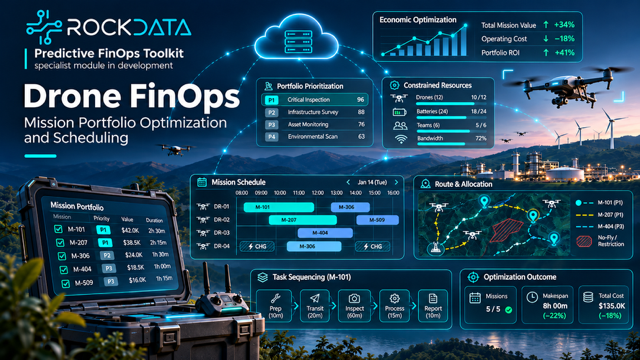
Excerpt: Choosing which missions to undertake, in what order and with which resources is an economic optimization problem. We explore mission portfolios, scheduling constraints and the planned optimization research within Rockdata’s Drone Flight FinOps Module.
A portfolio is more than a list of missions
Suppose we have fifteen potential missions but insufficient resources to complete all of them within the available operating window.
The decision is no longer simply how to fly each mission.
It becomes a question of which missions should be selected, in what sequence and with what allocation of resources.
Mission portfolio optimization must consider value, cost, deadlines, available equipment, operating restrictions and uncertainty.
A mission with high potential revenue may also have high operational risk or extensive processing requirements.
A lower-revenue mission may be more productive when performed near another scheduled site.
A simplified economic objective
Let:
- (x_i) indicate whether mission (i) is selected.
- (V_i) represent its expected accepted-output value.
- (C_i) represent its incremental cost.
A simplified objective is:
subject to constraints on available resources and mission feasibility.
This model is intentionally incomplete.
Actual scheduling may involve shared travel costs, precedence relationships, weather-dependent windows, regulatory restrictions, battery availability and uncertain outcomes.
Some costs depend on the combination and ordering of missions rather than on each mission independently.
Why aggregation changes the optimum
Consider two inspections at nearby locations.
Performing them on the same day might reduce travel and preparation overhead.
Yet combining them could also require different payload configurations or additional battery capacity.
An apparently efficient schedule may become infeasible because of operator availability, charging constraints or environmental conditions.
The optimum therefore belongs to the whole system, not to the individual aircraft.
Kolb experiment: schedule a hypothetical operating week
Construct a dataset containing twenty candidate missions.
For each, specify:
- Expected value.
- Estimated cost.
- Required payload.
- Operating duration.
- Location and time window.
- Resource requirements.
- Acceptance criteria.
Compare a first-come-first-served schedule with a schedule optimized for contribution margin under the same constraints.
Use simulated or synthetic information initially, not real-world autonomous flight assumptions.
Record the resulting total value, costs, accepted missions and resource utilization.
Then introduce uncertainty into mission duration or weather availability.
Does the apparently optimal schedule remain robust?
The planned FinOps capability
The proposed Mission Portfolio and Scheduling Optimizer within Rockdata Drone Flight FinOps will investigate:
- Multi-mission economic prioritization.
- Resource and capacity constraints.
- Scenario-based scheduling.
- Portfolio contribution analysis.
- Robust planning under uncertainty.
- Cost-versus-resilience trade-offs.
These are research objectives for a specialist module in development.
Conclusion
The economics of an individual mission cannot determine the economics of an entire operating schedule.
Shared resources, timing and mission interactions can change which decisions create the most value.
Mission portfolio optimization is the art of allocating limited capability among competing opportunities while preserving safety, quality and resilience.
Next: Drone FinOps — The Physics and Economics of Drone Flight.
Rockdata research note: This article contributes to the mission portfolio research for the specialist Drone Flight FinOps Module, in development within the Rockdata Predictive FinOps Toolkit.