
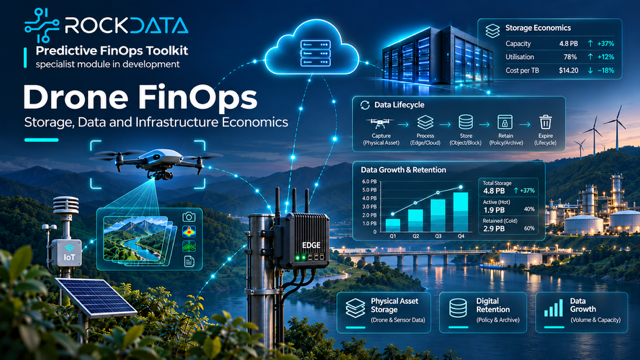
Excerpt: Drone storage has two meanings: preserving the aircraft and retaining the information it produces. We examine physical infrastructure, cloud storage, data retention and lifecycle costs for the developing Rockdata Drone Flight FinOps Module.
A drone consumes resources even when it is not flying
An aircraft needs somewhere to be stored.
Its batteries require suitable storage conditions and regular inspection. Equipment must be protected, inventoried, maintained and transported.
These costs exist before takeoff and continue after landing.
Drone missions also produce digital data.
Flight telemetry, photographs, video, geospatial products, processing intermediates and analytical results may require substantial storage capacity.
Thus, storage economics has two distinct dimensions: physical asset storage and digital information storage.
The physical storage problem
A complete cost model may include secure premises, environmental management, fire-safety arrangements, charging infrastructure, transport cases, inventory management and scheduled inspections.
Lithium-polymer batteries require particular care. Their storage and charging procedures must follow manufacturer guidance and applicable safety requirements.
We should allocate these expenses according to a documented cost policy.
They should not disappear from mission economics simply because no storage invoice is issued for an individual flight.
The digital storage problem
Consider a hypothetical mapping mission that produces 20 GB of raw data.
Suppose our operation performs thirty comparable missions each month.
The raw-data generation rate is:
Retaining twelve months of this raw data would imply 7.2 TB before accounting for derived products, backups, replicas, metadata and deletion policies.
The total retained footprint depends on the data lifecycle, not just the monthly capture rate.
Some data may only be needed during processing. Other datasets may require long-term retention for audit, scientific reproducibility or contractual obligations.
The hidden costs of information
Storage charges are only one part of the data lifecycle.
Other possible costs include:
- Upload bandwidth and transfer time.
- Data processing and transformation.
- Object storage and archival tiers.
- Replication and backup.
- Retrieval or egress charges.
- Metadata and indexing.
- Access control and security.
- Data verification and deletion.
The economically appropriate retention policy depends on the value of the data, legal requirements, recovery needs and the costs of recreating it.
A cheap storage tier may be expensive when data must be retrieved frequently.
Conversely, retaining every intermediate file indefinitely can create costs without proportional value.
Kolb experiment: model data growth
Define three simulated retention policies.
Policy A: Keep all raw and processed files in the highest-performance storage tier.
Policy B: Move infrequently accessed raw files to lower-cost archival storage after a defined period.
Policy C: Retain validated final products and only the raw material needed for contractual, recovery or research purposes.
Estimate twelve-month storage volume and total lifecycle costs for each policy.
Include retrieval and operational consequences, not merely storage price per gigabyte.
This is particularly relevant to Rockdata’s existing expertise in cloud cost management, big data and architecture.
The planned FinOps capability
The proposed Drone Storage and Data Lifecycle Economics component will investigate:
- Physical equipment storage allocation.
- Digital data growth forecasting.
- Storage-tier comparisons.
- Retention-policy economics.
- Processing and data-transfer costs.
- Data value versus retention cost.
This capability is being considered for the specialist Rockdata Drone Flight FinOps Module and is not yet presented as a released function.
Conclusion
The economics of flight extends beyond the flight itself.
The data produced by a mission may continue consuming resources for years.
Mission profitability must account for both the physical asset lifecycle and the information lifecycle.
Next: Drone FinOps — Planning, Estimation and Prediction Economics.
Rockdata research note: This investigation contributes to the specialist Drone Flight FinOps Module in development for the Rockdata Predictive FinOps Toolkit.