
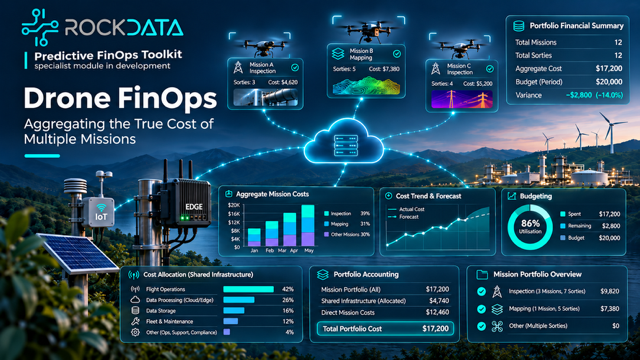
Excerpt: Twenty flights do not necessarily cost twenty times the price of one flight. We investigate shared costs, fixed capacity, marginal costs and allocation methods as part of the developing Rockdata Drone Flight FinOps Module.
Why individual-flight costing is insufficient
Once we have identified a portfolio of missions, we must determine what it costs to deliver that portfolio.
Some expenses are proportional to activity. Others are incurred regardless of whether the aircraft flies.
This distinction becomes important when evaluating alternative levels of demand.
A drone that completes five missions might incur substantial unused capacity costs. A drone completing thirty missions may need additional maintenance, personnel or batteries.
The cost relationship can therefore be nonlinear.
Constructing an aggregate cost model
We separate expenditure into three broad groups.
Direct variable costs arise from individual missions: battery consumption, mission-specific labor, processing and consumables.
Shared operating costs support multiple missions: storage, scheduling, software, training and equipment readiness.
Capital-related costs represent the economic consumption of longer-lived resources, such as the aircraft, charging equipment and sensors.
Our model becomes:
Here, (N) is the number of mission attempts, not necessarily the number of successful outcomes.
An illustrative monthly portfolio
Suppose we plan twelve inspection missions and eight mapping missions.
| Direct cost category | Calculation | Cost |
| Inspections | 12 × €22 | €264 |
| Mapping | 8 × €35 | €280 |
| Shared planning | Monthly allocation | €160 |
| Storage | Physical and digital | €70 |
| Processing infrastructure | Monthly allocation | €110 |
| Other shared and capital costs | Monthly allocation | €300 |
| Aggregate cost | €1,184 |
These are hypothetical accounting values.
If all twenty missions are accepted, average cost is:
But suppose only seventeen missions produce accepted outcomes.
Then:
The aggregate cost has not changed, but the cost per useful outcome has increased by approximately 17.6%.
This demonstrates why mission success and output quality belong inside the economic model.
The danger of allocation errors
Shared costs must not be counted twice.
For example, if the €22 direct inspection cost already includes operator labor, that labor should not also be included in the monthly shared allocation.
Likewise, equipment acquisition cost must be separated from depreciation.
A consistent costing policy is more important than creating an apparently precise result with inconsistent assumptions.
For portfolio decisions, it is also useful to distinguish incremental costs from allocated average costs. Accepting one additional mission may require little additional expenditure until an operational capacity threshold is reached.
Kolb experiment: change the portfolio
Use the model to simulate three demand scenarios: ten, twenty and thirty missions per month.
Keep the aircraft configuration constant initially.
Calculate aggregate costs and average cost per accepted mission for each scenario.
Then introduce capacity limitations. Does the thirty-mission scenario require another battery, more processing capacity or additional personnel?
Observe whether the cost curve changes abruptly.
Rockdata module development
This experiment contributes to the proposed Aggregate Mission Cost Engine within the Rockdata Drone Flight FinOps Module.
The planned capability will investigate cost attribution, shared-resource allocation, mission-level unit economics and portfolio forecasting.
The development objective is to identify both the visible costs of execution and the less visible costs of maintaining an operational capability.
Conclusion
The correct cost of a mission depends partly on the system supporting it.
A mission cannot be evaluated independently of shared infrastructure, capacity constraints and the rest of the portfolio.
The economic unit is the complete capability delivering a portfolio of accepted outcomes.
Next: Drone FinOps — Storage, Data and Infrastructure Economics.
Rockdata research note: This article supports the specialist Drone Flight FinOps Module, currently in development as part of the Rockdata Predictive FinOps Toolkit.