
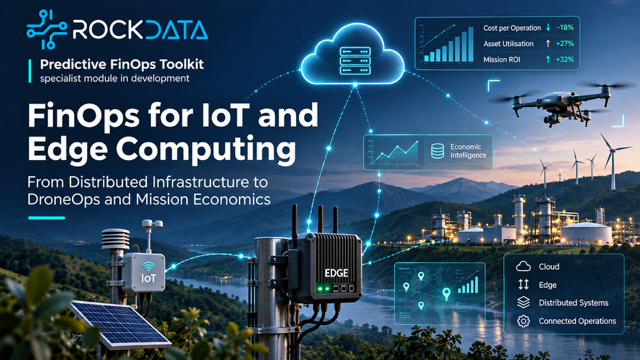
Excerpt: FinOps is expanding beyond the economics of cloud infrastructure. IoT, edge computing, robotics and autonomous systems introduce new challenges involving physical assets, energy, connectivity, data processing and mission outcomes. We explore how Rockdata’s Predictive FinOps Toolkit provides a foundation for understanding these distributed economic systems, and why a specialist DroneOps FinOps module is one of several applications under investigation.
1. FinOps is no longer just about the cloud bill
For many organizations, FinOps began as a way to understand, allocate and optimize public cloud expenditure.
Cloud platforms introduced flexible resource consumption models, allowing engineering teams to provision infrastructure rapidly while transferring significant financial responsibility to operational decisions.
FinOps helped bring financial accountability into this environment.
But modern technology systems rarely exist exclusively in the public cloud.
They increasingly span physical devices, sensors, industrial machinery, remote computing nodes, telecommunications networks, cloud-native services, AI models and data platforms.
These technologies have different cost structures, depreciation patterns, physical constraints and operating requirements.
A financial model focused solely on cloud invoices cannot explain the economics of the entire system.
This is particularly important for the Internet of Things (IoT) and edge computing.
The central question changes from:
“How much does our cloud infrastructure cost?”
to:
“What is the total economic cost of producing a useful business outcome across the complete distributed system?”
This broader perspective is consistent with the FinOps Foundation’s evolution toward technology value management, including cloud, SaaS, AI, data platforms and other defined technology spending scopes.
2. IoT and edge computing create a distributed economic system
Consider an industrial installation containing hundreds of sensors monitoring temperature, vibration, pressure and electrical consumption.
The sensors collect measurements, but the data must be transmitted, processed, interpreted, stored and converted into decisions.
Some processing might occur directly on a sensor or microcontroller.
More demanding calculations may run on an industrial edge gateway.
Historical analytics, AI model training, fleet monitoring and long-term storage may operate in a central cloud or data center.
The entire architecture constitutes a distributed system.
Its economic behavior cannot be understood by examining a single component in isolation.
A useful conceptual model is:
Physical assets → Sensing → Edge processing → Connectivity → Cloud and data platforms → Decisions → Business outcomes
Every stage consumes resources.
Every stage also creates capabilities, dependencies and potential value.
The engineering challenge is to select an architecture that performs the necessary work.
The FinOps challenge is to determine whether that architecture delivers the required outcomes at a justifiable total cost.
3. The economics of a device-to-cloud system
An IoT installation incurs several categories of expenditure.
Physical device economics
Sensors, controllers, cameras, communication modules and embedded computing hardware involve acquisition, installation, calibration, maintenance and eventual replacement.
Unlike many cloud resources, these assets cannot simply be deprovisioned when demand declines.
Their economic cost depends on useful service life, reliability, utilization and maintenance requirements.
Edge computing economics
Edge processing requires processors, memory, storage, operating systems, software, power and physical protection.
An edge device may reduce network traffic and cloud processing costs, but increases local equipment, management and maintenance obligations.
Connectivity economics
Networks have costs associated with subscriptions, bandwidth, gateways, communications hardware, reliability and deployment location.
A remote installation with intermittent connectivity may require additional local storage and synchronization mechanisms.
Cloud and data economics
Cloud platforms contribute ingestion, messaging, compute, object storage, analytics, security, AI inference and observability capabilities.
Their costs often vary with data volume, query patterns, processing intensity and retention policies.
Operational economics
Human effort is required to deploy, monitor, maintain and manage the complete system.
This includes technicians, engineers, analysts, support staff and the processes needed to handle failures.
A complete FinOps model must bring these components together without double-counting expenditure.
4. The important architectural question: where should computation happen?
Suppose a remote camera produces a continuous stream of images.
We have several possible architectural choices.
Architecture A: Cloud-centric processing
Transmit most of the data to a centralized cloud platform for processing and storage.
This may simplify centralized software management, but can increase transmission, ingestion and processing costs.
Architecture B: Edge-centric processing
Analyze the stream locally and transmit only selected events, metadata or compressed results.
This can reduce network usage and improve local responsiveness, but requires additional edge hardware, software management and maintenance.
Architecture C: Hybrid processing
Perform latency-sensitive filtering and inference at the edge while retaining centralized aggregation, model training and selected processing in the cloud.
No architecture is universally optimal.
The right answer depends on data volumes, processing requirements, latency, reliability, energy, security and lifecycle cost.
We must also consider costs that are not immediately visible.
Moving computation to the edge might reduce a recurring cloud bill while increasing equipment replacement, software deployment or field-service costs.
Equally, centralizing everything in the cloud may eliminate local complexity but create higher connectivity costs or unacceptable dependence on reliable network access.
These are first- and second-order economic effects of architectural decisions.
5. FinOps must connect infrastructure costs to business outcomes
Measuring expenditure is necessary, but insufficient.
A system can become cheaper while delivering less useful output.
Imagine a predictive maintenance deployment that detects emerging machinery failures.
The economic output is not the number of sensor readings collected.
It is the value of timely and reliable maintenance decisions.
Relevant measurements could include:
- Cost per monitored asset.
- Cost per validated anomaly detection.
- Cost per actionable maintenance recommendation.
- Avoided downtime attributable to the system.
- Time required to identify a fault.
- Cost of false alarms and missed detections.
The objective is to understand the relationship between resources consumed and useful outcomes.
This is the essence of unit economics applied to technology.
A generic model is:
Cost per accepted outcome = Total attributable system cost / Number of accepted outcomes
But this metric must be interpreted carefully.
An accepted outcome must have a clear definition, and an apparently low cost is not necessarily desirable if reliability, security or safety requirements have been weakened.
6. Why predictive FinOps matters for IoT and edge computing
IoT economics is particularly sensitive to scale.
A design that appears inexpensive for ten devices may become costly when deployed across ten thousand.
Small per-device differences in connectivity, storage, processing and maintenance can accumulate into substantial portfolio expenditure.
This makes early architectural estimation and scenario modeling valuable.
Consider a hypothetical deployment of 1,000 monitoring devices.
If each device produces 2 GB of retained data per day, the raw fleet generates approximately 60 TB over a 30-day month, before replication, intermediate processing or additional derived datasets.
Suppose edge filtering reduces transmitted and retained source data by 90%.
The corresponding source-data volume becomes approximately 6 TB per month.
That is a substantial difference in data volume.
However, the economic benefit is not automatically 90% of total system cost.
We must subtract the additional costs of edge processors, software development, maintenance, energy and operations, and verify that the filtering preserves required information.
A predictive FinOps approach would examine alternative architectures before large-scale deployment.
It would also compare forecasts against actual resource consumption after deployment.
7. Rockdata’s Predictive FinOps Toolkit as the economic foundation
At Rockdata, our work focuses on connecting technical architecture with financial performance.
The Rockdata Predictive FinOps Toolkit provides the foundation for analyzing ROI, price/performance decisions, resource allocation, capacity planning and the financial implications of engineering choices.
These principles are directly applicable to systems that extend beyond cloud infrastructure.
For IoT and edge computing, the opportunity is to develop specialist economic models that incorporate physical resource consumption alongside digital infrastructure costs.
Potential analytical capabilities include:
Business case modeling: Compare alternative deployment architectures, operating models and expected returns.
Aggregate cost attribution: Associate shared and variable expenditure with devices, sites, missions and accepted outcomes.
Capacity and demand forecasting: Estimate future processing, storage, bandwidth, power and maintenance requirements.
Unit economics: Measure the cost of useful observations, accepted decisions, operational tasks and other business outputs.
Scenario comparison: Explore the financial consequences of moving workloads between devices, edge nodes, on-premises infrastructure and public cloud services.
Forecast variance and learning: Compare predicted and actual cost, capacity and performance to improve future decisions.
Some of these analytical themes are already reflected in Rockdata’s published services. The IoT-specific implementations discussed here are prospective extensions and research directions, not claims of released product functionality.
The long-term objective is a consistent financial decision framework that can be adapted to different distributed technological systems.
8. Representative FinOps use cases for IoT and edge computing
The same economic method can be applied across very different industries.
Industrial IoT and predictive maintenance
Factories can collect equipment vibration, temperature and operating telemetry to identify potential failures.
FinOps can investigate sensor deployment costs, edge inference expenditure, data retention and the value of improved maintenance decisions.
Smart buildings and energy systems
Building management systems can use sensors and automated controls to monitor occupancy, temperature, lighting and energy consumption.
The economic model should include device installation and maintenance, energy savings, computing costs and the effectiveness of control decisions.
Agriculture and environmental monitoring
Distributed sensor networks can monitor soil conditions, irrigation, weather and equipment status.
Relevant measures include cost per monitored hectare, energy consumed, communication reliability and the economic value of timely interventions.
Logistics and asset tracking
Connected devices can monitor the location and condition of vehicles, containers and shipments.
FinOps can connect equipment, connectivity and analytics costs to accepted tracking events, operational efficiency and loss prevention.
Robotics and autonomous systems
Autonomous machines introduce additional physical constraints, including battery endurance, actuator wear, mechanical maintenance, mission duration and safety requirements.
These physical variables directly influence operational economics.
This leads us to a particularly useful experimental case: DroneOps.
9. DroneOps: one specialist application of IoT and Edge FinOps
A drone is a compact example of a distributed cyber-physical system.
It contains sensors, embedded processors, communication systems, mechanical actuators, batteries and real-time control software.
It collects and processes information locally while potentially interacting with remote operators, ground stations and cloud services.
It also has unusually visible physical constraints.
Every gram affects thrust.
Every watt contributes to energy consumption.
Every mission consumes battery life, equipment capacity and operational effort.
And every flight produces measurable telemetry.
These characteristics make drones useful for studying the connection between physical performance and economic outcomes.
Our chosen empirical platform is the Holybro X650 Development Kit, equipped with a Pixhawk autopilot.
We will use it to investigate the economics of multiple missions, flight planning, energy consumption, payload selection, data storage, estimation, prediction and operational learning.
The objective is not merely to build an aircraft.
It is to understand the full economics of a repeatable mission-delivery capability.
10. Developing the Rockdata DroneOps FinOps specialist module
As one application of this broader research, we are investigating a specialist Rockdata Drone Flight FinOps Module, currently in development as part of the Rockdata toolkit.
The proposed module will explore how flight telemetry, mission planning, physical models, capital costs and operational data can be integrated into a coherent economic decision framework.
Its research domains include:
- Mission portfolio business cases and aggregate economics.
- Aircraft, battery and payload lifecycle costs.
- Storage, connectivity and data-processing costs.
- Mission planning, estimation and prediction.
- Flight physics, energy consumption and operational constraints.
- Actual-versus-predicted mission performance.
- Empirical learning and continuous model improvement.
- Fleet capacity and investment scenarios.
The drone module is not intended to define the limits of the toolkit.
It provides a concrete, measurable use case from which broader IoT and edge economic models can be explored.
The same conceptual approach could inform specialist modules for industrial equipment, connected vehicles, renewable energy systems or other distributed assets.
Each domain will require its own physical models, data definitions and validation procedures.
11. Kolb’s experiential learning cycle as the development method
To avoid constructing theoretical models disconnected from operational reality, the research will follow Kolb’s experiential learning cycle.
Concrete experience
Build and operate a physical experimental system, or execute a controlled simulation, and collect its measurements.
Reflective observation
Compare actual consumption, costs and outcomes against prior expectations.
Abstract conceptualization
Develop or revise explanatory models of energy, resource utilization, cost and performance.
Active experimentation
Use those models to design controlled tests and evaluate alternative engineering decisions.
For example, we might predict that a change in payload mass will affect energy consumption by a certain amount.
We can then measure the actual behavior of the X650, inspect discrepancies and revise the physical-economic model.
That revised model can improve later mission estimates and investment decisions.
The process continues iteratively.
This is empirical FinOps: using operational evidence to improve the economic decisions embedded within engineering design.
12. From monitoring costs to engineering for economic outcomes
The deeper opportunity is to move FinOps earlier in the technology lifecycle.
Traditional cost management often begins after expenditure has occurred.
A predictive approach can inform decisions before infrastructure is purchased, deployed or scaled.
In IoT and edge systems, this means asking economic questions during architecture and engineering design.
Should processing occur locally or in the cloud?
How much data should be retained?
What level of redundancy is justified?
Which sensor configuration provides adequate information quality?
When should equipment be maintained or replaced?
How much capacity should be purchased now, and how much flexibility should be preserved for later?
These decisions connect business objectives to system architecture and physical constraints.
The appropriate goal is not indiscriminate cost reduction.
It is to maximize sustainable economic value while meeting functional, performance, reliability, security and safety requirements.
Conclusion: FinOps for the complete cyber-physical system
IoT and edge computing require an economic perspective that spans both digital and physical resources.
The cost of a useful result may depend simultaneously on sensors, processors, batteries, communications networks, software, cloud infrastructure, maintenance and human expertise.
Optimizing one component independently can produce unintended costs elsewhere in the system.
Rockdata’s Predictive FinOps approach provides a foundation for evaluating these architectural and economic trade-offs.
DroneOps is one practical application through which we intend to investigate and validate specialist economic models.
The broader objective is to develop methods that connect engineering choices, resource consumption and business outcomes across distributed technological systems.
The governing principle is simple: optimize the value delivered by the complete system, not merely the cost of its individual components.
In the next article, we begin the Drone FinOps research series by asking the most important business question: what portfolio of missions justifies establishing a drone capability in the first place?
About Rockdata and this research
Rockdata specializes in FinOps, cloud architecture, data engineering and the financial evaluation of technology decisions.
The Rockdata Predictive FinOps Toolkit supports the company’s approach to cost analysis, architecture evaluation and financial decision-making.
The specialist Drone Flight FinOps Module described in this article is currently in development. Its proposed functions represent research objectives and are not claims of generally available product capabilities.
This article introduces the broader IoT and Edge FinOps research context for the Economics of Flight series.